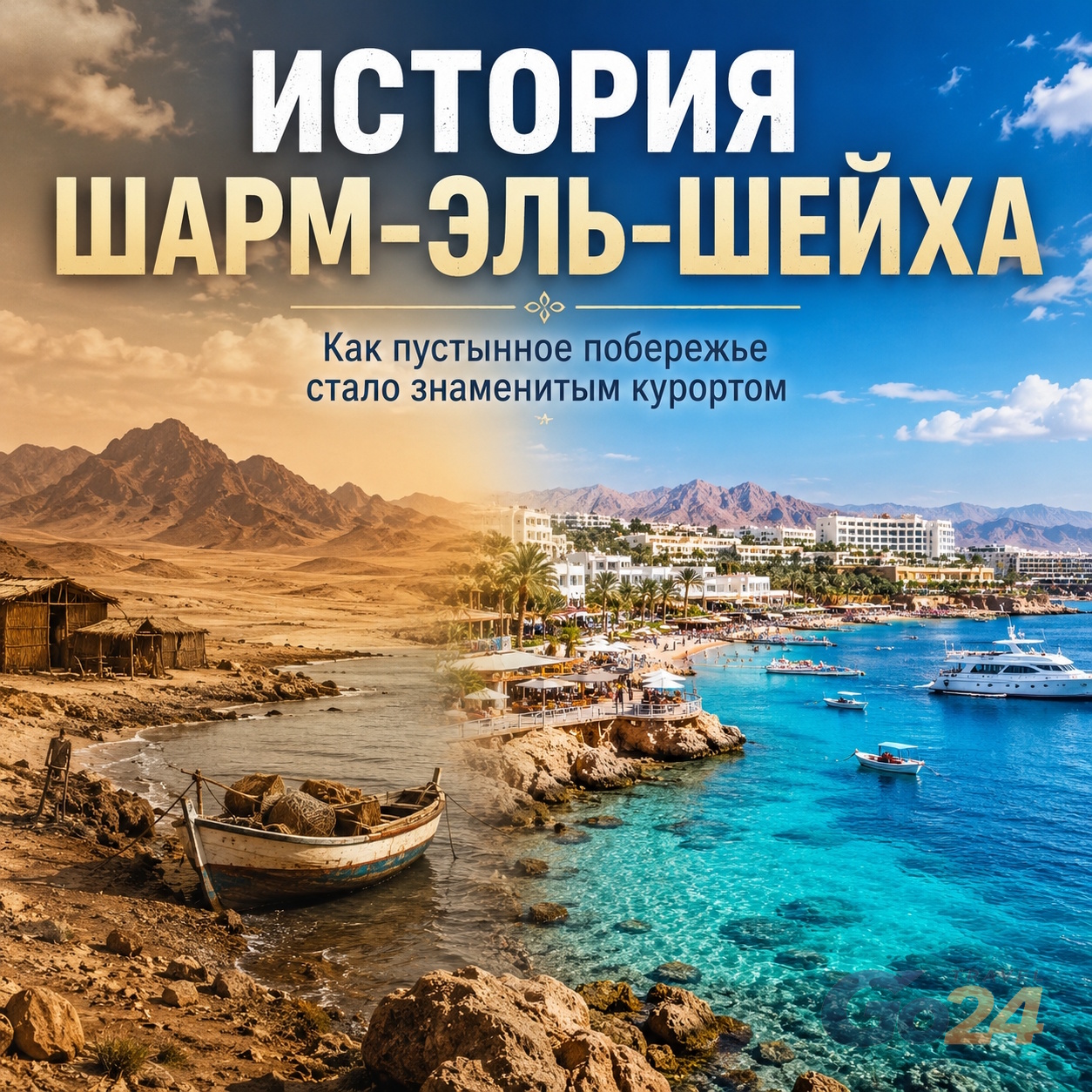
The history of Sharm El Sheikh is surprisingly short for a city in a land of ancient civilizations. A modern resort with an international airport, hundreds of hotels and well-known tourist areas grew up on the desert coast of South Sinai in only a few decades.
Why does the name Ophira appear in old sources, when did Naama Bay appear and what role did the Red Sea coral reefs play in the city's development?
In brief: Sharm El Sheikh was not renamed from Ophira. Ophira is the name of an Israeli settlement that existed in this area during Israel's control of South Sinai. After the territory was returned to Egypt in 1982, the city developed under its Arabic name — Sharm El Sheikh.
Before the resort
Sharm El Sheikh is located at the southern tip of the Sinai Peninsula, near the entrance to the Gulf of Aqaba and the Strait of Tiran. This strait connects the gulf with the Red Sea, so control of the passage was important for shipping and the security of the region.
Until the second half of the 20th century there was no large city here. The coast was used by Bedouin communities, fishermen and the military. The arid climate, lack of fresh water and remoteness from large settlements long held back permanent building.
The name Sharm el-Sheikh is usually translated from Arabic as "the sheikh's bay". In Russian-language sources the variants "Sharm-el-Sheikh" and "Sharm-esh-Sheikh" appear — these are different ways of rendering the same Arabic name.
Why the place was considered strategic
The position next to the Strait of Tiran repeatedly made the area a participant in Middle Eastern conflicts. In 1956, during the Suez Crisis, the territory was occupied by Israel, and in 1957 it was returned to Egypt. Until 1967 UN peacekeeping forces were stationed in the area.
During the Six-Day War of 1967 Israel occupied the Sinai Peninsula, including the area of the future resort. This is when the period connected with the name Ophira begins.
Ophira and the first tourist facilities
Ophira was an Israeli settlement created in the Sharm El Sheikh area after 1967. The name did not refer to the whole of South Sinai and is not the former Egyptian name of the modern city.
Between 1967 and 1982 roads, residential and military facilities, an airfield and basic infrastructure were built. A small amount of tourist development of the coast also began: diving attracted travelers with clear water and reefs, and the first leisure facilities appeared in the Naama Bay area. So the history of Sharm El Sheikh as a tourist destination began even before the modern Egyptian resort appeared.
Studies of tourism development on the Red Sea note that in this period early hotel and diving facilities operated in Naama Bay. However, in scale they are not comparable with the resort that formed later under Egypt.
What appeared in this period
- roads and engineering infrastructure;
- an airfield and military facilities;
- the settlement of Ophira;
- the first small hotels and diving centers;
- early tourist development of Naama Bay.
What did not yet exist
- a modern international resort;
- today's network of large hotels;
- the developed areas of Nabq and Sharks Bay;
- a long tourist agglomeration along the shore;
- today's airport passenger traffic.
How Sharm El Sheikh returned to Egyptian control
The turning point was the Camp David Accords of 1978 and the peace treaty between Egypt and Israel signed on March 26, 1979. The treaty provided for the withdrawal of Israeli armed forces and civilians from the Sinai Peninsula and the restoration of Egyptian sovereignty.
The withdrawal took place in stages. On April 25, 1982 the main territory of Sinai, including Sharm El Sheikh, returned to Egyptian control. The text of the treaty and documents on the negotiations are available in the archives of the Office of the Historian of the US Department of State and UN treaty database.
After the transfer of the territory, the Egyptian authorities kept part of the infrastructure and began to develop the city as an international tourist center. So 1982 can be considered the start of a new stage, from which the history of Sharm El Sheikh is connected with the rapid growth of Egyptian tourism.
How Sharm El Sheikh became an international resort
The modern history of Sharm El Sheikh is above all a history of rapid expansion along the coast: from the old bay and Naama Bay to the airport, Sharks Bay and Nabq.
After the return of Sinai, Egypt made tourism one of the main directions of development of South Sinai. At first growth was concentrated in Naama Bay: the sandy bay, proximity to the airport and a convenient coastline suited the building of hotels, restaurants and a promenade.
Scientific and economic studies of the time recorded very rapid growth. If in the mid-1980s Sharm remained a small settlement, in the following years dozens of hotels, new roads and tourist areas appeared along the coast.
How the areas of modern Sharm formed
- Sharm El Maya and the Old Town developed near the historic bay, the port and the old part of the settlement.
- Hadaba and Ras Um Sid took the plateau and the shore north of the old bay; the area became known for hotels, reefs and viewpoints.
- Naama Bay became the first main tourist center with a beach, promenade, restaurants and nightlife.
- Sharks Bay and Ras Nasrani developed north of Naama Bay, closer to the airport and the reefs of the Strait of Tiran.
- Nabq Bay became a large resort zone even further north, where big hotel complexes and new infrastructure appeared.
These areas did not appear at the same time. The resort expanded along the coast in waves: first Naama Bay and the central bays, then the territories closer to the airport, Sharks Bay and Nabq.
The Red Sea — the basis of Sharm El Sheikh's popularity
Hotels could have been built elsewhere, but the uniqueness of Sharm El Sheikh was determined by the Red Sea. Coral reefs run along the coast, and the deep clear water and rich underwater world made the area famous among divers.
The reefs of the Ras Mohammed National Park and the Strait of Tiran played a special role. According to materials of the Egyptian environmental agency, Ras Mohammed became Egypt's first national park in 1983; the protected territory was later expanded. Nature protection helped preserve the resort's main asset, although the rapid growth of hotels has at the same time put pressure on the coast.
Today you can see the reefs during sea excursions in Sharm El Sheikh section, trips to Ras Mohammed and White Island or trips to Tiran Island.
Why Sharm is called the city of peace
Over time the resort became not only a place for a beach holiday but also a venue for international meetings. Diplomatic talks, economic forums and major conferences have been held here. For this role Sharm El Sheikh is often called the "city of peace".
The modern stage continued this tradition: in 2022 the city hosted the UN climate conference COP27. International events stimulated the renewal of roads, the airport, public spaces and hotel infrastructure.
History of Sharm El Sheikh: key dates
What remains from the different stages of history
The history of Sharm El Sheikh can be read in its geography. The old bay of Sharm El Maya is connected with the port and the early settlement. Naama Bay recalls the first stage of tourist development. And Sharks Bay, Ras Nasrani and Nabq show how the resort gradually moved north along the coast.
Sharm El Sheikh grew quickly, so there is no single historic center here like Cairo or Alexandria. It is a chain of bays, residential quarters and resort zones united by a road, the airport and common tourist infrastructure.
Frequently asked questions
What was Sharm El Sheikh called before?
The area itself had the Arabic name Sharm El Sheikh. Ophira is the name of an Israeli settlement created here after 1967, not the former name of the whole Egyptian city.
When was Sharm El Sheikh returned to Egypt?
The main territory of the Sinai Peninsula, including Sharm El Sheikh, returned to Egyptian control on April 25, 1982 under the 1979 peace treaty with Israel.
Who built the first hotels in Sharm El Sheikh?
The first small tourist facilities and diving centers appeared during Israeli control of South Sinai. After 1982 Egypt expanded the resort many times over: large hotels, the airport, promenades and new areas appeared.
Which area of Sharm appeared first?
The old part of the settlement was at Sharm El Maya, and the first main center of resort development was Naama Bay. The more northern hotel zones were built up actively later.
Why did Sharm El Sheikh become popular?
The main reasons are coral reefs, the warm Red Sea, diving, a sunny climate, an international airport and large hotels. Ras Mohammed and the reefs of the Strait of Tiran became especially famous.
How old is the modern resort?
Early tourist development began in the 1970s, but rapid growth of the international Egyptian resort began after 1982. Most of the modern urban and hotel infrastructure appeared over the last four decades.
Want to see modern Sharm El Sheikh?
Take a look at excursions, boat trips and trips around South Sinai — from Ras Mohammed to Mount Moses.